Are Split Systems Expensive to Run in Perth (Updated 2026)?
Many customers are surprised when I tell them how inexpensive split system air conditioners are to run. The short answer: no, a modern split system is one of the cheapest ways to heat or cool a Perth home. But the longer answer depends on the size of your unit, how you use it, and what you’re paying for electricity.
This guide covers exactly what you’ll pay to run a split system in Perth in 2026, broken down by unit size and season, plus practical tips to keep your bills as low as possible.
Quick Summary: Are split systems expensive?
- A correctly sized modern split system costs roughly $0.20–$0.65 per hour to run depending on capacity
- Running costs depend on unit size (kW), energy star rating, thermostat setting, and how long it runs
- The best air con temperature in summer is 23℃ to 24℃ for comfort and 25℃ to 27℃ for cost efficiency
- The best air con temperature in winter is around 18 to 20°C for efficiency and 21 to 22℃ for comfort
- Heating with a reverse cycle split system is cheaper than gas ducted heating in most Perth homes
- Regardless of the season, professional split system installation, proper maintenance, a yearly inspection, and the properly sized unit can optimise your split system’s efficiency
What Affects How Much a Split System Costs to Run?
Five things have the biggest impact on your running costs. Understanding them helps you choose the right unit and use it efficiently.
Unit Capacity (kW)
A 2.5kW unit draws far less electricity than a 7.1kW unit. This is the single biggest factor. The key is matching the unit size to the room — an oversized unit cycles on and off constantly (less efficient), and an undersized unit runs flat out trying to reach temperature (also expensive). Our split system calculator can help you find the right size.
Energy Star Rating
More stars means lower electricity use for the same output. Modern inverter-driven split systems adjust their output up and down rather than switching fully on or off, making them significantly more efficient than older fixed-speed models. A 5-star Daikin or Mitsubishi will cost less to run annually than a cheaper 3-star unit — often enough to offset the price difference within a few years.
Thermostat Setting
Every degree you set below 24°C in summer (or above 22°C in winter) adds roughly 10% to your running cost. This is the easiest thing to control. For most Perth homes, 24–26°C in summer and 20–22°C in winter hits the sweet spot between comfortable and cost-efficient.
How Long You Run It
Running your unit 4 hours in the evening costs half as much as running it 8 hours. Using the timer function to pre-cool before you get home — rather than running all day — is one of the simplest ways to reduce your bill.
Perth Electricity Rates
Synergy’s standard residential tariff in Perth is approximately 31–34 cents per kWh in 2026 depending on your plan. This is the figure used in the cost estimates below.
Learn More: Split System vs Multi Head Split System
Split System Running Costs by Unit Size
The table below shows estimated running costs for modern inverter split systems at typical Perth usage. Input power (the electricity the unit actually draws) is approximately 30–40% lower than the rated output capacity for a quality inverter unit.
| Unit Size | Typical Input Power | Cost Per Hour | Cost Per Day (8 hrs) | Cost Per Month (8 hrs/day) |
| 2.5kW — small bedroom | ~0.7kW | ~$0.23 | ~$1.85 | ~$55 |
| 3.5kW — large bedroom | ~1.0kW | ~$0.33 | ~$2.65 | ~$79 |
| 5.0kW — open-plan living | ~1.4kW | ~$0.46 | ~$3.70 | ~$111 |
| 7.1kW — large open plan | ~2.0kW | ~$0.66 | ~$5.25 | ~$158 |
Estimates based on Synergy rate of ~$0.33/kWh and a modern 4–5 star inverter unit. Actual costs vary by model, thermostat setting, insulation, and ambient temperature. An older or poorly maintained unit will cost more.
How Much Does It Cost to Run a Split System in Perth Summer?
Perth summers are long and hot. Most homes run their split system heavily from November through March. For a typical 3.5kW unit running 8 hours per day over a 90-day summer, you’re looking at roughly $220–$260 added to your power bills for the season.
That’s for one unit, running at a reasonable thermostat setting. Running at 20°C instead of 24°C, or running all day while you’re at work, will push that figure noticeably higher.
The most effective thing you can do in summer is keep the thermostat at 24–26°C and use your ceiling fan in combination, the fan helps distribute cool air so the unit doesn’t have to work as hard. If you’re looking at installation options for a new unit ahead of summer, now is a good time to plan.
7 Ways to Reduce Your Split System Running Costs in Perth
- Set the thermostat to 24–26°C for cooling, 20–22°C for heating Every degree closer to outside temperature saves roughly 10% on running cost. It’s the single most impactful habit.
- Use the timer, don’t run it while you’re out. Pre-cool the house 30 minutes before you arrive rather than running all day. Most split systems have a built-in timer.
- Keep doors and windows closed A sealed room cools and heats in a fraction of the time. Even a slightly open door significantly increases the load on the unit.
- Clean your filters every 4–6 weeks A clogged filter makes the unit work harder for the same output. It takes 2 minutes and can meaningfully reduce running cost. This is the most commonly skipped maintenance task.
- Use ceiling fans to distribute air A ceiling fan allows you to set the thermostat 2–3 degrees warmer in summer without feeling the difference. At a few cents per hour to run, the saving is worth it.
- Make sure your unit is correctly sized for the room An oversized unit cycles on and off (inefficient). An undersized unit runs flat out (also inefficient and hard on the compressor). If you’re not sure whether your current unit is right for your room, use our split system calculator.
- Service your unit every 1–2 years A unit with a refrigerant leak, dirty coils, or a struggling compressor uses more electricity for less output. A service catches these issues early.
If you want to learn more about reducing your energy usage in summer, I put together this guide to help: 7 Tips for Efficient Energy Use in Summer.
Is My Old Split System Costing Me More Than It Should?
If your split system is more than 10 years old, there’s a reasonable case for replacing it on running cost grounds alone. Inverter technology and energy efficiency ratings have improved significantly over the last decade. A modern 5-star unit will use noticeably less electricity than a 10-year-old fixed-speed model of the same rated capacity.
Signs your unit may be costing more than it should:
- The room takes much longer than it used to to reach temperature
- Your power bills have crept up without an obvious change in usage habits
- The unit cycles on and off frequently rather than running steadily
- It’s been more than 2 years since a service
- It’s a fixed-speed (non-inverter) model, common in units over 10 years old
We’re not in the business of recommending replacements for units that are working fine. But if your system is showing these signs, it’s worth a conversation. View our supply and installation pricing to get an idea of what a new unit costs and factor in the running cost savings over the next 5–10 years.
Frequently Asked Questions
How much does it cost to run a 2.5kW split system per day in Perth?
A 2.5kW split system running for 8 hours costs approximately $1.70–$2.00 per day at current Perth electricity rates. Over a 90-day summer, that’s around $150–$180 for the season from that one unit.
Is it cheaper to leave the split system on all day or turn it off and on?
In most cases, turning it off when you leave and on when you return is cheaper — unless you’re only gone for an hour or less. The energy used to re-cool a room that’s warmed up is less than the cost of maintaining temperature through the heat of a Perth day.
Does running a split system on heating cost more than cooling?
Generally, heating costs slightly less than cooling in Perth. The outdoor temperature in winter is much closer to the target indoor temperature, so the unit doesn’t have to work as hard.
What is the most energy-efficient temperature to set a split system?
For cooling: 24–26°C. For heating: 20–22°C. Every degree you move away from these ranges adds approximately 10% to running cost.
How do I know if my split system is using too much electricity?
Common signs are: longer time to reach temperature than it used to, power bills higher than expected, the unit cycling on and off frequently, or the unit running constantly without reaching the set temperature. The most common causes are a dirty filter, an incorrectly sized unit, or a unit due for a service.
You May Also Like: Energy Saving Tips in Winter
Thinking About a New Split System for Your Perth Home?
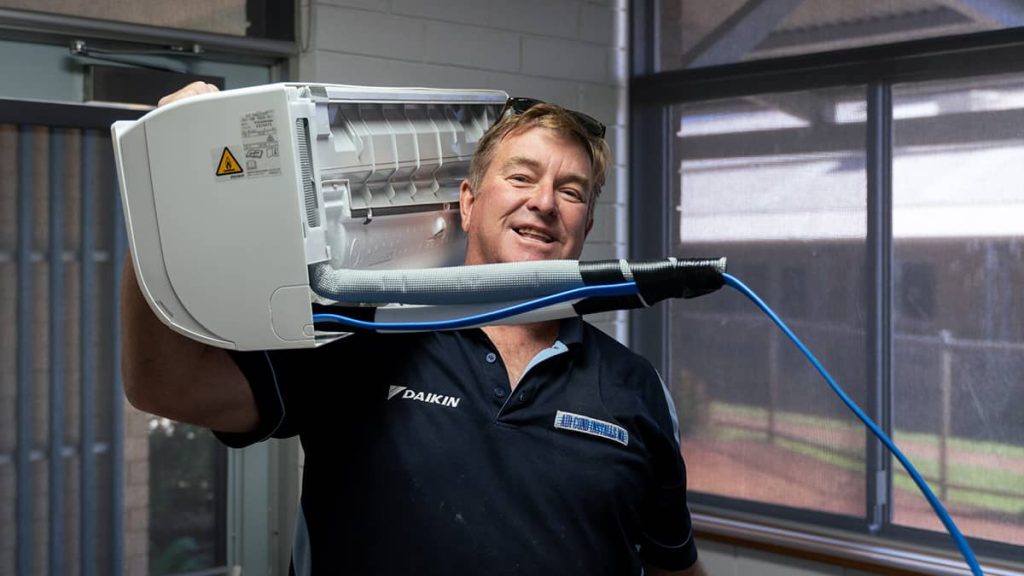
If you’re weighing up the running cost of a new unit versus your existing system, or you want advice on the most efficient brand and size for your home, we’re happy to help. Wayne and Glenn have been installing split systems across Perth’s northern suburbs for over 30 years, honest advice, no sales pitch, and a fixed price in writing before any work starts.
Get a free quote or view our installation options to see what’s involved.