How Long Does a Split-System Air Conditioner Last in Perth?
A well-installed and properly maintained split-system air conditioner will commonly last around 10 to 15 years. Some systems continue working beyond 15 years, while others may need replacing sooner due to heavy use, corrosion, poor installation, incorrect sizing or other issues.
That 10 to 15-year range is best treated as a practical guide rather than an expiry date. A 12-year-old air conditioner that still heats and cools effectively without recurring problems may have useful life left in it. On the other hand, a much younger unit that regularly breaks down or struggles through summer may warrant closer attention.
Here in Perth, air conditioners also have to deal with some challenging conditions. Long periods of summer use, extremely hot days, dust and debris around outdoor units, and salt exposure near the coast can all influence how a system ages.
With more than 30 years of combined industry experience, Wayne and Glen from Air-Cond Installs WA have installed and replaced split systems in homes throughout Perth. When looking at an ageing system, its condition and performance are just as important as the number on its installation date.
What is the average lifespan of a split-system air conditioner?
For many households, 10 to 15 years is a reasonable expectation for the useful life of a split-system air conditioner when it has been correctly selected, installed and maintained.
However, there is an important distinction between an air conditioner that still turns on and one that is still performing well.
An older system might continue running beyond 15 years but take longer to cool the room, become noisier, require increasingly frequent repairs or consume more electricity to maintain the desired temperature. At that point, the question becomes less about whether the system technically works and more about whether keeping it represents good value.
Likewise, reaching 10 years does not automatically mean an air conditioner needs replacing. A well-performing system with no significant faults may continue providing reliable heating and cooling for years.
A useful way to think about air conditioner life expectancy is:
| System age | What homeowners should consider |
|---|---|
| Under 5 years | Performance problems may point towards maintenance, installation or warranty concerns rather than normal age |
| 5–10 years | Continue appropriate maintenance and monitor performance, noise, reliability and energy consumption |
| 10–15 years | Consider repair costs, overall condition, reliability and efficiency when deciding whether replacement makes sense |
| Over 15 years | Assess whether continued repairs are worthwhile compared with the reliability, efficiency and warranty of a replacement |
These are review stages, not fixed replacement dates.
It is also important not to confuse the manufacturer’s warranty with the expected lifespan of the equipment. A five-year product warranty, for example, does not mean the air conditioner is designed to last only five years. Warranty coverage and expected service life are separate considerations.
What determines how long an air conditioner lasts?
There is no single factor that determines split-system lifespan. Two identical systems installed in different homes can experience very different operating conditions over 10 or 15 years.
The following factors can have a significant influence.
Installation quality
The lifespan of a split system starts with its installation.
Correct mounting, pipework, drainage, commissioning and positioning of the indoor and outdoor units all contribute to reliable operation. The outdoor unit also needs suitable airflow, secure mounting and sufficient access for future inspection and maintenance.
Poor installation can create problems long before the equipment itself would normally be expected to wear out.
Correct installation gives a new system the best chance of operating reliably, so it is worth understanding the available professional split-system installation options before choosing a location.
Correct system size
Bigger is not automatically better when choosing an air conditioner.
An undersized unit can struggle to achieve the desired room temperature, particularly during prolonged periods of hot Perth weather. That may result in long operating periods as the system attempts to keep up with the cooling demand. Oversizing can create different performance issues, including frequent cycling.
The appropriate capacity depends on much more than floor area alone. Room dimensions, insulation, ceiling height, windows, orientation and sun exposure can all influence the cooling or heating load.
If you are considering replacing an existing unit, our split-system size calculator provides a useful starting point for estimating the capacity your room may require.
Frequency and intensity of use
An air conditioner used occasionally in a spare bedroom has a very different workload from a living-room system operating for hours every day throughout summer.
Perth’s hot weather can place substantial demand on air conditioning, particularly during extended periods of high temperatures. Reverse-cycle systems may also be used during winter, increasing their annual operating hours.
How the system is used matters too. Leaving external doors or windows open while the air conditioner is running increases the cooling or heating load. Setting an unrealistically low temperature on a very hot day can also cause the system to work for extended periods.
This does not mean you should avoid using your air conditioner when you need it. It simply helps explain why two systems of the same age can be in very different condition.
Cleaning and maintenance
Basic maintenance can help prevent an air conditioner from working harder than necessary.
For homeowners, one of the most important tasks is keeping the indoor unit’s filters clean according to the manufacturer’s instructions. Dirty filters can restrict airflow and reduce performance.
One of the simplest maintenance jobs is following the correct process for cleaning your split-system filter.
It is also worth periodically checking that the outdoor unit has not become surrounded by leaves, vegetation, stored belongings or other obstructions. Maintenance should remain within the tasks that can be performed safely by the homeowner. Do not dismantle the system or attempt work involving electrical components or refrigerant.
Brand, model and parts availability
Equipment quality and product selection can influence the usable life of an air conditioner, but there is no responsible way to say that one particular brand will always last longer than another.
The individual model, how it is installed, how heavily it is used and the conditions it operates in all matter. Parts availability and manufacturer support also become increasingly important as equipment ages. Even if an older unit can theoretically be repaired, replacement may become more practical if an important component is difficult or expensive to source.
You can view the split-system brands we supply and install when comparing replacement options.
Outdoor-unit location and airflow
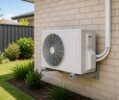
The outdoor condenser needs room to operate effectively. Manufacturer clearance requirements should be followed, and the unit should not be boxed into a poorly ventilated space or allowed to become surrounded by vegetation and debris.
Where practical, outdoor-unit positioning should also consider:
- Suitable airflow
- Secure mounting
- Future service access
- Exposure to irrigation or sprinklers
- Leaves and garden debris
- Heat around the installation area
- Environmental exposure
A convenient installation position is not necessarily the best long-term location for the equipment.
Coastal salt and corrosion
This is particularly relevant in Perth.
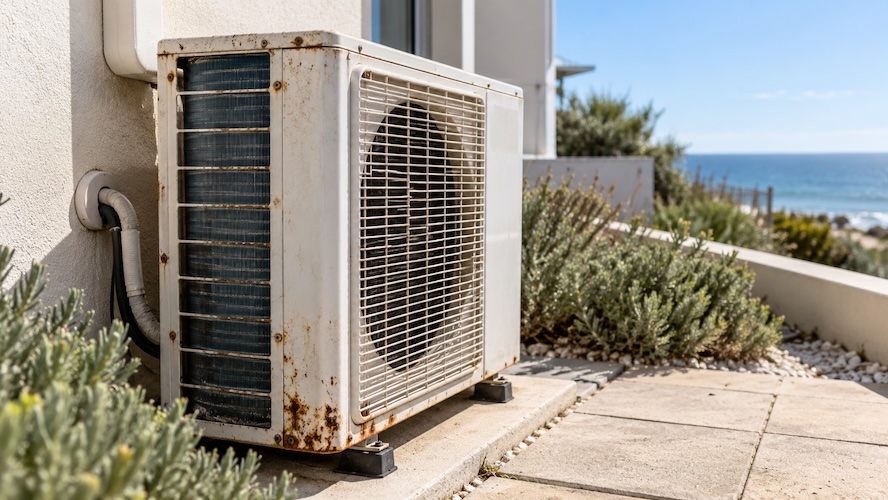
Homes in coastal areas such as Scarborough, Trigg, Hillarys, Ocean Reef, Jindalee and Alkimos can expose outdoor air-conditioning equipment to greater levels of airborne salt.
Salt can contribute to corrosion of outdoor components over time. The amount of exposure varies considerably depending on the property’s location, distance from the ocean, prevailing conditions and where the condenser is positioned around the home.
There is therefore no reliable rule such as saying a coastal system will last a particular number of years less than an inland system. Instead, equipment selection, installation position, manufacturer recommendations, protective features and ongoing maintenance should be considered for the individual property.
Does Perth’s climate affect air-conditioner lifespan?
Yes. Where an air conditioner operates can influence how hard it works and the conditions its components are exposed to.
Perth combines several factors worth considering.
- Extended summer heat: A main living-area system may operate for long periods during hot weather, particularly during heatwaves.
- Strong afternoon sun: A west-facing room with large windows can experience substantial afternoon heat gain. A system selected purely according to floor area may not adequately account for that additional cooling load.
- Hotter inland conditions: Homes further from the coast can experience different summer conditions from properties close to the ocean. Correct sizing becomes particularly important for rooms exposed to significant heat.
- Coastal conditions: Closer to the coast, salt exposure and corrosion may become a greater consideration when choosing where to position the outdoor unit.
- Dust and debris: Outdoor units need adequate airflow. Leaves, vegetation, dust and other debris accumulating around the condenser can interfere with the environment in which it operates.
Year-round operation: Reverse-cycle air conditioners used for both summer cooling and winter heating can accumulate considerably more operating hours than cooling-only systems used for a few months each year.
For example, when assessing a west-facing living area in an inland Perth suburb, Wayne and Glen would need to consider factors such as room size, windows, insulation and afternoon sun rather than selecting capacity from floor area alone.
At a coastal Perth property, the assessment may place greater emphasis on where the outdoor condenser can be positioned and how exposed that location will be to coastal conditions.
These are examples of the factors considered during an installation rather than descriptions of specific customer projects. The appropriate recommendation ultimately depends on the individual home.
Signs your air conditioner may be nearing the end of its life
Age provides useful context, but it should not be considered in isolation.
Warning signs worth investigating include:
- Cooling or heating taking noticeably longer
- Difficulty reaching the set temperature
- Frequent or recurring repairs
- An apparent increase in electricity consumption
- New or persistent noises
- Visible corrosion or physical deterioration
- Replacement components becoming difficult to obtain
- An older refrigerant being used
- Recurring leaks or drainage problems
One problem does not necessarily mean the air conditioner needs replacing. A technician may find a straightforward repair or maintenance issue. However, several problems appearing together on an ageing system can change the equation.
Age is only one factor. These signs it may be time to replace your split system can help you assess its overall condition in more detail.
Should you repair or replace an older air conditioner?
There is no universal age or repair price at which replacement automatically becomes the right choice. Instead, consider what you are spending and what you are likely to get in return.
A repair may be reasonable when:
- The air conditioner is relatively young
- The problem is isolated and repairable
- The system otherwise performs well
- Suitable replacement parts remain readily available
- The fault is covered by warranty
- A qualified technician expects the system to remain reliable following the repair
For example, replacing a repairable component on an otherwise reliable system is very different from spending heavily on an ageing unit that has already experienced several significant problems.
Replacement may make more sense when:
- The system is approaching or beyond its expected service life
- Significant faults keep returning
- A major component has failed
- Suitable parts are becoming difficult to source
- Heating or cooling performance has noticeably declined
- The system has become excessively noisy
- Electricity consumption is a concern
- The proposed repair is expensive relative to replacement
For an older unit, consider the total repair cost, not simply whether a repair is technically possible. Compare that cost with what a suitable new system would provide, including a new product warranty, current technology and potentially improved efficiency.
You can compare a proposed repair with our current split-system supply and installation prices before deciding which option offers better long-term value.
Can an old air conditioner still be expensive to run?
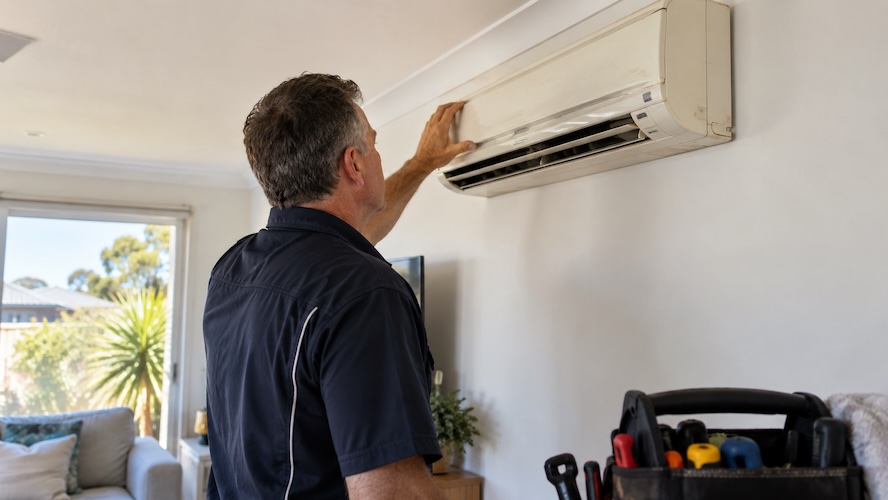
Yes. An air conditioner does not have to stop working completely before it becomes worth reassessing. An ageing unit may remain operational while requiring longer operating periods to achieve the same result.
Running costs can also be affected by factors unrelated to age, including:
- Dirty components
- Incorrect system sizing
- Poor insulation
- Large areas of exposed glass
- Direct afternoon sun
- Doors and windows being left open
- The temperature selected
- The efficiency of the particular system
This is why a higher electricity bill should not automatically be blamed on the age of the air conditioner.
If you want to understand electricity consumption in more detail, see our guide explaining how much split systems cost to run.
How can you help a split system last longer?
You cannot prevent normal wear and component ageing, but good operation and maintenance can give your air conditioner the best opportunity to provide reliable service.
Here are some practical steps:
- Clean the filters regularly. Follow the manufacturer’s instructions and avoid allowing heavy dust build-up to restrict airflow.
- Keep the outdoor unit clear. Do not allow leaves, vegetation, boxes or stored belongings to obstruct airflow around the condenser.
- Use sensible temperature settings. Extremely low cooling settings will not make an undersized system suddenly cool a room faster.
- Close doors and windows. Avoid continually introducing hot outside air while the system is trying to cool the room.
- Pay attention to changes. New noises, leaks, declining airflow or sudden changes in performance are worth investigating rather than ignoring.
- Do not pressure wash or dismantle the unit. Cleaning that requires opening equipment should be left to an appropriately qualified person.
- Use qualified assistance for technical faults. Refrigerant and electrical problems are not DIY maintenance jobs.
- Choose the correct capacity when replacing a system. Appropriate sizing helps the system deal with the actual heating and cooling requirements of the room.
- Follow warranty and maintenance requirements. Check the instructions supplied by the manufacturer of your particular system.
- Consider coastal exposure. If you live close to the ocean, pay particular attention to the condition and location of the outdoor unit.
Perhaps most importantly, do not wait until an ageing air conditioner completely fails before thinking about what comes next.
If a system is approaching 10 to 15 years old, knowing its condition, capacity and potential replacement options can make the eventual decision much easier.
What happens to the old system when it is replaced?
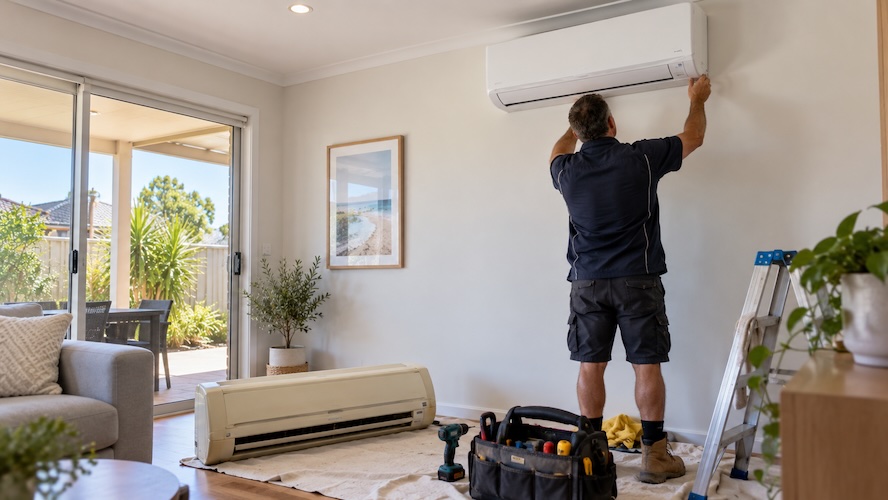
Replacing a split system involves more than taking the indoor unit off the wall. Air conditioners contain refrigerant and need to be properly decommissioned. The old indoor and outdoor units, associated components and installation materials also need to be dealt with appropriately. This is particularly important when replacing equipment that has been installed for many years.
Air-Cond Installs WA can arrange compliant air-conditioner removal and disposal when installing a replacement, helping leave the installation area ready for the new system.
Planning a replacement split system in Perth
If your existing system is approaching the end of its useful life, you do not necessarily need to wait for a complete breakdown before considering your options.
Start by gathering some basic information:
- Record the make and model of your current system
- Estimate when it was installed
- Note any recent repairs or recurring faults
- Consider whether it still heats and cools the room effectively
- Think about whether your use of the room has changed
- Check whether the existing location provides effective airflow
- Reconsider whether the current capacity is suitable
- Compare available replacement systems and installation arrangements
This can be particularly useful if you have purchased an older Perth home and inherited an air conditioner without knowing its installation history. A replacement also provides an opportunity to reconsider decisions made many years ago. The existing unit does not necessarily need to be replaced with an identical capacity in exactly the same position. Room use may have changed, renovations may have altered the space, or the previous system may never have been ideally sized in the first place.
If your existing system is becoming unreliable, you can explore our split-system installation options or request a free installation quote from Wayne and Glen.
Frequently asked questions
How many years does a split-system air conditioner last?
A well-installed and appropriately maintained split-system air conditioner commonly lasts around 10 to 15 years. Some units operate for longer, while others require replacement sooner. Usage, sizing, installation, maintenance, environmental exposure and the condition of the individual system all influence its useful life.
Can an air conditioner last 20 years?
Yes, some air conditioners remain operational for 20 years or longer. However, continued operation does not necessarily mean an older system remains reliable, efficient or economical to repair. Its performance, physical condition, repair history, parts availability and electricity consumption should all be considered.
How do I know when my air conditioner needs replacing?
Declining heating or cooling performance, recurring breakdowns, unusual noises, physical deterioration, expensive repairs and difficulty obtaining parts can all indicate that replacement is worth considering. The age of the system provides additional context but should not be the only reason for replacing it.
Is it worth repairing a 10-year-old air conditioner?
It can be. A modest repair on an otherwise reliable 10-year-old system may be worthwhile. A major repair on a system that has declining performance, recurring faults or other ageing components may offer poorer long-term value. Compare the repair required with the overall condition of the system and the cost and benefits of replacement.
Do split systems last longer if they are serviced?
Appropriate cleaning and maintenance can help prevent unnecessary strain and identify some problems before they become more serious. Maintenance cannot stop normal components from ageing, but it can support the reliable and efficient operation of the system over its service life.
Does coastal air shorten an air conditioner’s life?
Salt exposure can contribute to corrosion of an outdoor air-conditioning unit, making the operating environment an important consideration for coastal Perth homes. The impact varies depending on factors such as distance from the coast, equipment selection, outdoor-unit position, protection and maintenance, so there is no fixed number of years that should be deducted from a system’s expected lifespan.
Need to replace an ageing split system?
There is no single birthday at which an air conditioner becomes “too old”. For many split systems, 10 to 15 years is a useful benchmark, but condition, performance, reliability and repair history tell you much more than age alone.
If your system is getting older but continues to perform reliably, appropriate maintenance and monitoring may be all that is required. If it is struggling through Perth summers, breaking down repeatedly or becoming increasingly expensive to keep going, it may be time to compare your options.
Not sure whether your old split system has more life left in it? Wayne and Glen can assess your requirements, explain your replacement options and provide a clear quote for a correctly sized new system.